Affiliate disclosure: Links in this post are affiliate links. I may earn a commission if you sign up through them, at no additional cost to you.

Deel vs. Remote 2026: Full EOR Comparison
Deel or Remote? Compare pricing, country coverage, compliance, platform UX, and support — with a verdict on which EOR provider fits your hiring strategy in 2026.
4/28/20266 min read
Deel vs. Remote: The Ultimate EOR Comparison for 2026
Who Should Read This
You're scaling a team across borders. You need an Employer of Record — a platform that legally employs your international hires, handles payroll, manages compliance, and keeps you out of legal hot water in countries where you have no entity. Two names keep coming up: Deel and Remote.
This article breaks down both platforms across seven evaluation criteria, based on publicly available data, user reviews, and platform documentation. No filler. No fluff. Just what you need to make the call.
1. Country Coverage: Who Can Hire Where
Deel operates in 150+ countries, making it one of the broadest EOR networks in the market. It achieves this through a hybrid model — a mix of owned legal entities and vetted in-country partners. This gives Deel the ability to move fast when you need to hire in a new market on short notice.
Remote covers 80+ countries, but its key differentiator here is that it operates exclusively through fully owned legal entities — no third-party partners. For companies where compliance assurance is non-negotiable, this matters. Every hire goes through Remote's own local infrastructure, which reduces the risk of liability gaps that can sometimes appear in partner-based models.
Verdict: Deel wins on raw breadth. Remote wins on structural assurance. If you're hiring in frontier markets or need maximum geographic flexibility, Deel has the edge. If you're concentrated in major markets and want zero ambiguity about who's legally responsible, Remote's model may be worth the narrower footprint.
2. Pricing Structure: What You'll Actually Pay
Both platforms have moved toward public pricing, which is a win for buyers doing honest comparisons.
Deel's pricing:
EOR: From $599/employee/month
Contractors: From $49/contractor/month
Global Payroll (for companies with entities): Custom pricing
HRIS for full-time employees: Free up to 200 employees (as of 2025)
Remote's pricing:
EOR: From $599/employee/month
Contractors: From $29/contractor/month
Global Payroll: From $50/employee/month
HRIS: Free tier available
At the EOR level, both platforms are priced identically at the floor. The real differentiation emerges at higher volumes, where custom enterprise contracts come into play, and in the contractor tier, where Remote has a visible price advantage at $29 vs. $49 per contractor.
One important note: EOR pricing is rarely apples-to-apples. Country-specific statutory costs, local benefits mandates, and one-time onboarding fees can vary significantly. Always request an itemized quote for your specific hiring markets before making a final cost comparison.
Verdict: Remote has a lower entry price for contractor-heavy teams. For EOR at scale, both are competitive at the base rate, but Deel's enterprise flexibility and bundled HRIS may reduce total cost of ownership for larger organizations.
3. Compliance and Legal Infrastructure
This is where the stakes are highest. Getting compliance wrong means fines, lawsuits, and reputational damage.
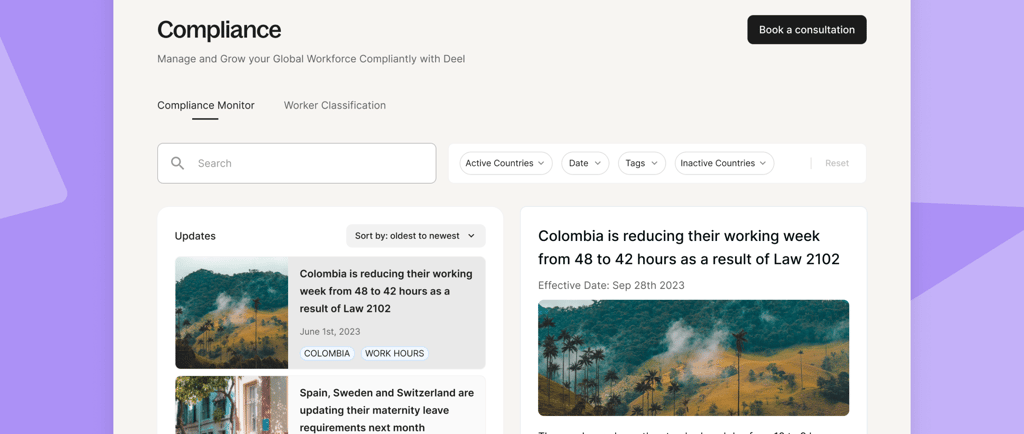
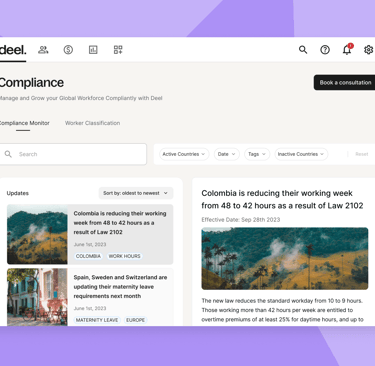
Deel has built Deel Shield, its IP and compliance protection layer. It includes misclassification risk assessments, auto-generated locally compliant contracts, and a legal team that monitors regulatory changes in real time. Deel also offers built-in support for stock options, equity grants, and SAFEs — critical for startups compensating international hires with equity.
Remote counters with its Intellectual Property Guard, which reassigns IP rights from the local employed entity back to your company — a genuinely important protection that some EOR providers don't offer at all. Remote's fully owned entity model also means it bears direct legal responsibility as the employer of record, which simplifies your compliance posture significantly.
Both platforms provide locally compliant employment contracts, handle statutory benefits, and manage tax filings in each operating country. Both maintain dedicated legal and compliance teams.
Verdict: Both platforms are strong here, and the difference is largely structural. Remote's owned-entity model provides cleaner legal separation. Deel's compliance tooling is arguably more feature-rich, particularly for startups navigating equity compensation internationally.
4. Platform UX and HRIS Capabilities
Beyond the legal infrastructure, you and your HR team will live inside this platform daily. Usability matters.
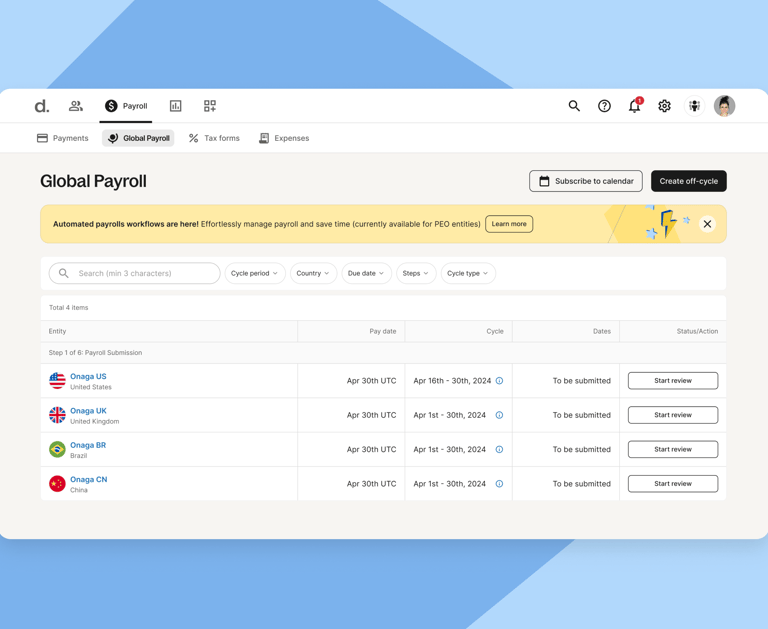
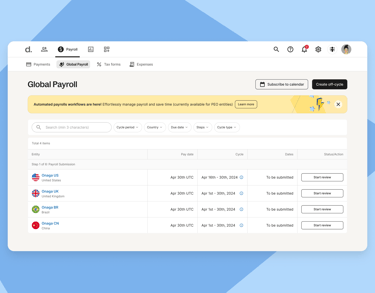
Deel's platform has evolved significantly from a contracts tool into a full workforce management suite. It includes an integrated HRIS, payroll runs, document management, an employee self-service portal, time-off tracking, expense management, and an app marketplace with integrations for tools like Slack, QuickBooks, BambooHR, and Workday. The interface is widely cited in user reviews as clean and intuitive, particularly for onboarding new hires quickly.
Remote's platform similarly covers the full employee lifecycle — onboarding, payroll, benefits, time off, and expense management. Remote has invested heavily in its self-serve experience, and its employee portal consistently gets positive marks from end users (the employees you hire) rather than just the admins managing them. Its reporting and analytics layer is also noted as a strength in enterprise reviews.
G2 Ratings (as of early 2026):
Deel: 4.8 / 5 (5,000+ reviews)
Remote: 4.6 / 5 (1,500+ reviews)
Deel's higher volume of reviews partly reflects its longer market presence and larger customer base, so the ratings shouldn't be read in isolation — but the signal is consistent: both platforms are well-regarded, with Deel holding a slight user satisfaction edge.
Verdict: Deel edges Remote on volume of positive user feedback and breadth of integrations. Remote's platform is strong and particularly praised for its employee-side experience.
5. Customer Support
When something goes wrong with international payroll or a compliance question surfaces at 11pm before a deadline, support quality becomes the most important feature on the list.
Deel offers 24/7 live chat support, with dedicated customer success managers available on higher-tier plans. Response times are generally fast, and the platform's in-app support is tightly integrated with its compliance documentation.
Remote also offers 24/7 support and provides dedicated account managers to customers above a certain threshold. Remote is frequently praised in reviews for the quality of its compliance-specific support — their in-country legal expertise is often cited as a differentiator when handling edge-case employment scenarios.
Verdict: Both platforms deliver solid support. Deel tends to win on speed and responsiveness for general queries. Remote tends to win on depth of expertise for complex, jurisdiction-specific compliance questions.
6. Contractor Management
Not every international worker is a full-time employee. Many fast-growing teams start with contractors before converting to full-time hires, or maintain a permanent contractor layer for project-based work.
Deel built its reputation on contractor management before expanding into EOR. Its contractor tools are mature: automatic compliance checks, multi-currency payments, consolidated invoicing, and country-specific contract templates that minimize misclassification risk. Deel supports contractor payments in 150+ currencies.
Remote offers contractor management as part of its platform and has strengthened this offering over time. Its lower price point ($29/month) makes it attractive for teams with large contractor networks. Remote also provides misclassification risk assessments and locally compliant agreements.
Verdict: Deel has deeper contractor tooling and broader currency support, reflecting its origins as a contractor payment platform. Remote offers better pricing for teams primarily managing contractors rather than full-time employees.
7. Best-Fit Scenarios: When to Choose Each
Choose Deel if:
You need to hire in emerging or frontier markets where Remote doesn't yet operate
You're a startup or scale-up that needs to move fast and wants onboarding completed in days, not weeks
Your team includes a mix of contractors and full-time employees across many countries and you want one unified platform
You're offering equity compensation to international employees and need built-in support for that complexity
You want the broadest integration ecosystem for connecting your HR stack
Choose Remote if:
Compliance certainty is your top priority and you want the assurance of fully owned entities in every market you hire
Your hiring is concentrated in major markets where Remote's 80+ country footprint covers you completely
You have a contractor-heavy team and want to manage them at a lower per-seat cost
Employee experience matters as much as admin experience — Remote's employee-side portal is often preferred by workers
You're in a regulated industry where the cleaner legal structure of owned entities reduces audit and liability risk
The Bottom Line
Neither Deel nor Remote is objectively "the best" EOR provider in 2026 — the right answer depends on where you're hiring, how you're growing, and what you're optimizing for.
Deel is the better choice for teams that need geographic breadth, speed, and a feature-rich platform that handles the full contractor-to-employee lifecycle. Its scale, integrations, and equity tools make it particularly well-suited for high-growth startups and companies with complex, multi-country hiring needs.
Remote is the better choice for teams that prioritize structural compliance assurance, want the security of fully owned legal entities, and are concentrated in established markets. Its clean entity model and strong employee experience make it a compelling option for companies where getting compliance exactly right — not just approximately right — is a non-negotiable.
Both platforms offer free demos. If you're still on the fence, the most efficient next step is to run both demos with your specific hiring countries and headcount in mind, request itemized pricing, and ask each provider directly how they handle employment in your three most complex jurisdictions. The answers will tell you more than any comparison article can.
info@peopleandfinance.org